
The Real Cost of Receiving International Payments in Nigeria
Imagine this: A Nigerian freelancer receives $500 from a US client through Payoneer. On paper, that’s ₦250,000 at the official rate. But after fees, currency conversion charges, and withdrawal costs, they actually receive ₦215,000 in their bank account. That’s ₦35,000 gone—14% of their earnings—simply because they didn’t choose the right payment platform.
This scenario plays out thousands of times daily across Nigeria. Freelancers, virtual assistants, content creators, and developers earn in dollars and pounds, but lose significant portions to hidden fees and unfavorable exchange rates. Over a year, a freelancer earning $2,000 monthly could lose between ₦400,000 and ₦600,000 simply through inefficient payment methods.
The difference between using the cheapest and most expensive platform isn’t just a few hundred naira—it’s the difference between financial stability and constant struggle. This guide breaks down exactly how much each major platform charges and shows you which one actually lets you keep the most of what you earn.
Why Nigerian Freelancers Lose Money to Fees
The problem isn’t that payment platforms are inherently expensive. The problem is that most freelancers don’t understand how these platforms actually work, and they make decisions based on convenience rather than cost.
The Hidden Fee Structure
When you receive international payments in Nigeria, multiple layers of fees apply simultaneously. First, there’s the receiving fee—what the platform charges just to accept the payment into your account. Then comes currency conversion, where the platform takes a margin above the real exchange rate. Finally, when you withdraw to your Nigerian bank account, another fee applies.
Most platforms hide these costs in different ways. Some advertise low receiving fees but charge high conversion rates. Others offer fair exchange rates but charge steep withdrawal fees. A few charge modest fees everywhere but make their money through wider exchange rate spreads that you never see directly.
Why Exchange Rate Margins Matter
This is where most freelancers get blindsided. When you convert $1,000 USD to NGN, the real market rate (called the mid-market rate) might be ₦1,550 per dollar. But platforms don’t give you the mid-market rate. They add a margin—sometimes 1%, sometimes 3%, sometimes even more. That margin is invisible because it’s built into the rate they show you.
On a $1,000 conversion, a 2% margin costs you ₦31,000. On a $5,000 conversion, it costs ₦155,000. Over twelve months of regular payments, these invisible margins can total ₦500,000 or more—money that simply disappears without appearing as a line item on any fee schedule.
The Frequency Problem
Freelancers who receive payments weekly or bi-weekly face compounding fee problems. If you receive $200 twice a week, that’s ₦52,000 in potential fees and margin losses per month, assuming a 2% total cost per transaction. Over a year, that’s ₦624,000 lost to fees alone—not counting any other business expenses.
Understanding these layers is crucial because it changes how you evaluate platforms. A platform that charges 0.8% on receiving but adds 2% to the exchange rate is actually more expensive than one charging 1.5% on receiving with a fair exchange rate.
Platform Comparison: Fees Breakdown for 2026
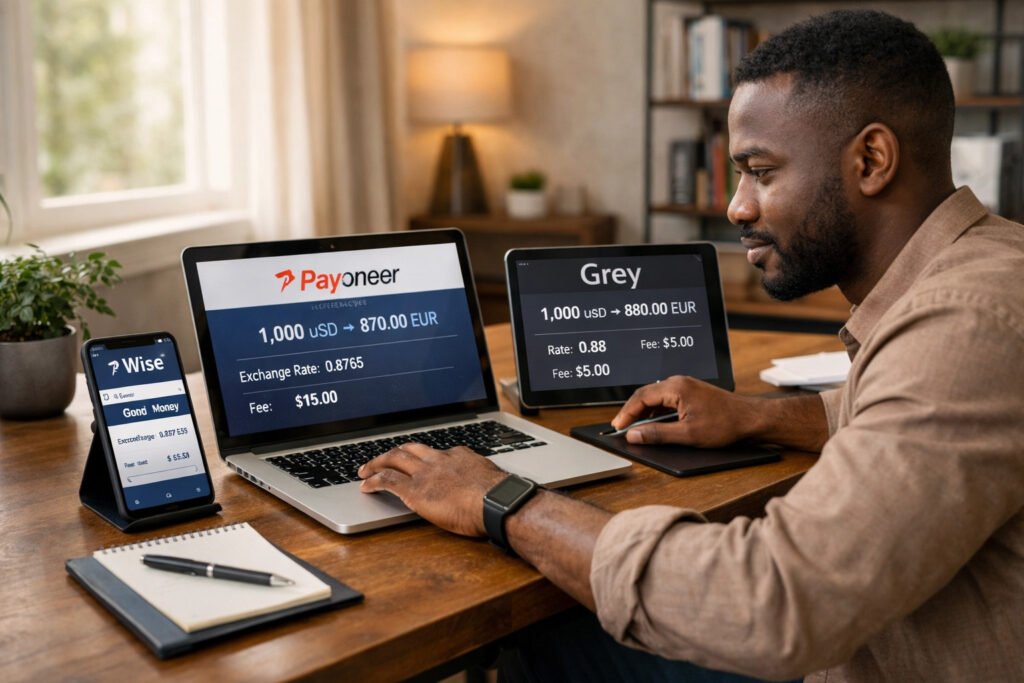
To help you make an informed decision, here’s a detailed comparison of the four most popular payment platforms for Nigerian freelancers. The data reflects current 2026 pricing and fee structures.
Payoneer: The Established Giant
Payoneer remains one of the most widely accepted platforms globally, with direct integrations to Upwork, Fiverr, and thousands of other platforms. This accessibility comes at a cost.
Receiving Fees: When payments come from marketplaces like Upwork or Fiverr, fees vary by platform. Direct payments from clients via credit card cost up to 3.99%. ACH transfers from the US cost 1%. PayPal transfers cost 3.99% plus $0.49.
Currency Conversion: Up to 3.5% when converting between currencies.
Withdrawal to Nigerian Bank: 1-4% depending on your account status and transaction volume. High-earning customers (over $50,000 monthly) pay 0.5%.
Card Fees: $29.95 annual fee for the Payoneer card. ATM withdrawals cost $3.15 plus up to 1.8% for same-currency transactions, or $3.15 plus up to 3.5% for cross-currency withdrawals.
Annual Account Fee: $29.95 if you receive less than $2,000 in any 12-month period.
Real Example: A freelancer receives $500 from Upwork. Upwork’s fee (typically 20%) is deducted before it reaches Payoneer, leaving $400. Payoneer charges 1% receiving fee ($4), then 3% conversion ($12), then 2% withdrawal ($8). Final amount: ₦185,000 instead of ₦250,000. That’s 26% lost to fees and deductions.
Wise: The Transparent Challenger
Wise (formerly TransferWise) built its reputation on transparency and mid-market exchange rates. It’s particularly strong for receiving direct bank transfers and for moving money between countries.
Receiving Fees: Free to receive in 8+ major currencies if you have a Wise Business account. Personal accounts pay $6.11 for USD wire transfers, €2.39 for EUR SWIFT, £2.16 for GBP SWIFT.
Currency Conversion: 0.33-1.2% depending on the currency pair. Wise uses the actual mid-market rate, so there’s no hidden margin.
Withdrawal to Nigerian Bank: Wise doesn’t directly withdraw to Nigerian banks. Instead, you convert to NGN and transfer via their partner banks, typically costing 0.33-1.2%.
Card Fees: £7 to order. Free transactions in the card’s currency. Cross-currency transactions cost 1.5-2%.
Real Example: A freelancer receives $500 via bank transfer to their Wise account. Wise charges $1.50 receiving fee, then 0.5% conversion ($2.50). Final amount: ₦765,000 after converting at mid-market rate. That’s only 3% lost to fees—significantly better than Payoneer.
Grey.co: The Emerging Favorite
Grey (formerly Abeg) has gained popularity among Nigerian freelancers because it was specifically designed for this use case. You get foreign account details to receive payments directly, then manage them from Nigeria.
Receiving Fees: 0.8% when receiving foreign payments, capped at $10. So whether you receive $100 or $10,000, you never pay more than $10 in receiving fees.
Currency Conversion: 1% when converting currency.
Withdrawal to Nigerian Bank: Flat ₦35 per withdrawal, regardless of amount.
Virtual Card: $2 setup fee. 2% plus $0.50 for non-USD transactions.
Real Example: A freelancer receives $500 directly to their Grey USD account. Grey charges $4 receiving fee (0.8% capped at $10), then 1% conversion ($5), then ₦35 withdrawal fee. Final amount: ₦743,000. That’s only 3% lost to fees, and the withdrawal fee is negligible on larger amounts.
Geegpay (Raenest): The Flexible Option
Geegpay, now operating under the Raenest umbrella, offers similar functionality to Grey but with slightly different fee structures.
Receiving Fees: 0.8% for USD (minimum $1.50, capped at $12). 0.7% for GBP and EUR with their own minimums.
Currency Conversion: Charged separately at rates that vary based on market conditions.
Withdrawal to Nigerian Bank: ₦12 per withdrawal.
Virtual Card: $3 to create, $0.50 to fund, $0.50 per transaction.
Real Example: A freelancer receives $500 to their Geegpay account. Geegpay charges $4 receiving fee (0.8%), then conversion fees, then ₦12 withdrawal. Total fees are similar to Grey but slightly higher due to the per-transaction card fees if you use their card.
Binance P2P: The Crypto Option
For freelancers comfortable with cryptocurrency, Binance P2P offers an alternative. You receive payments in crypto, then convert to NGN through peer-to-peer trading.
Fees: Typically 1-2% depending on the trader and market conditions.
Advantages: No account freezes, fast transfers, global accessibility.
Disadvantages: Requires crypto knowledge, more volatile, regulatory uncertainty in Nigeria.
Fee Calculator: See Your Actual Earnings
To make this concrete, let’s calculate what a freelancer actually receives across different platforms when they get paid $500 monthly for a year ($6,000 total).
| Platform | Receiving Fees | Conversion Fees | Withdrawal Fees | Total Fees | Actual NGN Received |
|---|---|---|---|---|---|
| Payoneer | $60 | $180 | $120 | $360 | ₦2,820,000 |
| Wise | $9 | $30 | $0 | $39 | ₦2,931,000 |
| Grey.co | $48 | $60 | ₦420 | ~$110 | ₦2,895,000 |
| Geegpay | $48 | $60 | ₦144 | ~$110 | ₦2,895,000 |
| Market Rate (No Fees) | $0 | $0 | $0 | $0 | ₦3,000,000 |
Key Insight: Over one year, choosing Wise over Payoneer saves you ₦111,000. Choosing Grey or Geegpay over Payoneer saves you ₦75,000. These aren’t small differences—they’re the difference between affording rent or not.
Which Platform Is Best for Your Situation?
The “best” platform depends entirely on your earning pattern, the currencies you receive, and how frequently you need access to your money.
Best for Students and Part-Time Freelancers
If you earn less than $500 monthly and receive payments irregularly, Wise is your best choice. The low fees and transparent rates mean you lose the least money. The receiving fees are higher than Grey, but on small amounts, this matters less than the fair exchange rates.
Best for Full-Time Freelancers with Regular Income
If you receive $1,000+ monthly consistently, Grey.co or Geegpay are superior. The capped receiving fees ($10 maximum) mean your fees don’t scale with transaction size. Over a year of regular payments, this saves you significantly compared to percentage-based fees.
Best for Marketplace Integration
If you work primarily through Upwork, Fiverr, or similar platforms, Payoneer remains the most convenient because of direct integrations. However, understand that you’re paying a convenience premium. Consider using Payoneer to receive from the marketplace, then transferring your balance to Wise for conversion and withdrawal.
Best for Maximum Flexibility
Grey.co offers the best balance of low fees, foreign account access, and flexibility. You can hold multiple currencies, use the virtual card for online purchases, and withdraw whenever you want with minimal fees.
Best for Crypto-Comfortable Freelancers
Binance P2P works if you’re comfortable with cryptocurrency and understand the regulatory landscape. It offers the lowest fees and fastest transfers, but comes with volatility and regulatory uncertainty.
Security and Compliance: Protecting Your Money
Receiving international payments in Nigeria comes with regulatory considerations. The Central Bank of Nigeria (CBN) has specific guidelines about foreign exchange transactions and domiciliary accounts.
CBN Regulations and Your Account
As of 2026, the CBN has relaxed many restrictions on domiciliary accounts. Freelancers can now receive international payments more freely than in previous years. However, compliance remains important:
Know Your Customer (KYC) Requirements: All legitimate platforms require full identity verification. This protects both you and the platform. Never use services that don’t require proper KYC—they’re likely operating illegally.
Transaction Reporting: Large transactions (typically above $10,000) may be reported to authorities. This is normal and legal. Keep documentation of your income sources.
Avoiding Account Freezes: Account freezes typically happen when platforms detect suspicious activity or when you violate their terms. To avoid this:
- Use your real name and consistent information across platforms
- Keep your account activity consistent with your stated profession
- Don’t receive payments from suspicious sources
- Don’t attempt to circumvent platform rules or hide transaction sources
- Maintain documentation of your client relationships
Platform Safety Rankings
All four major platforms (Payoneer, Wise, Grey, Geegpay) are legitimate and regulated. However, they have different safety profiles:
Wise is the safest for regulatory compliance. It’s heavily regulated in multiple countries and maintains the highest security standards.
Payoneer is well-established and trusted, but has faced occasional account freezes in Nigeria. This is typically resolved quickly if you have proper documentation.
Grey.co and Geegpay are newer but growing rapidly. They’re compliant with Nigerian regulations and specifically designed for the Nigerian market, which can be an advantage.
Step-by-Step: Setting Up Your Top Two Choices
To maximize security and minimize fees, consider using two platforms: one for receiving (based on where your clients pay from) and one for conversion and withdrawal (based on fees).
Setting Up Wise
- Download the Wise app or visit wise.com
- Click “Send Money” or “Get Started”
- Enter your personal details and verify your email
- Upload a government-issued ID (international passport, driver’s license)
- Provide proof of address (utility bill, bank statement)
- Create a Wise account
- Add your Nigerian bank account as a recipient
- Request a USD account number (you’ll receive US bank details)
- Share these details with clients who can pay via US bank transfer
Verification Time: Usually 1-2 hours
First Transfer: Can receive within 24 hours
Setting Up Grey.co
- Visit grey.co and click “Get Started”
- Enter your email and create a password
- Verify your email address
- Complete KYC verification:
- Upload government-issued ID
- Take a selfie for facial recognition
- Provide proof of address
- Once approved, you’ll see your dashboard
- Click “Get Account Details” to receive your USD, GBP, or EUR account numbers
- Share these details with clients
- Funds arrive within 1-3 business days
- Convert to NGN when rates are favorable
- Withdraw to your Nigerian bank account
Verification Time: Usually 2-4 hours
First Transfer: Can receive within 24 hours
Recommended Setup for Maximum Savings
For Upwork/Fiverr freelancers: Keep Payoneer for marketplace integration, but transfer your balance to Wise monthly for conversion and withdrawal.
For direct client payments: Set up Grey.co to receive directly. Convert and withdraw when rates are favorable.
For maximum flexibility: Use both Grey and Wise. Receive in Grey (lower fees), convert in Wise (better rates), withdraw from either depending on urgency.
Frequently Asked Questions
Q: Which platform has the lowest fees for Nigerians?
A: For regular payments, Grey.co and Geegpay have the lowest total fees because their receiving fees are capped. For one-time or irregular payments, Wise offers the best rates due to transparent mid-market pricing.
Q: Can I receive USD directly to my Nigerian bank account?
A: Yes, but with limitations. Most Nigerian banks charge high fees for direct USD transfers. It’s cheaper to receive via a platform like Grey or Wise, then convert and withdraw. Some banks like Zenith and GTB offer special domiciliary accounts that accept USD directly at lower fees.
Q: Are Grey.co and Geegpay safe and legal?
A: Yes. Both are licensed and compliant with Nigerian regulations. They’re specifically designed for the Nigerian market and have proper regulatory approval. Thousands of Nigerian freelancers use them successfully.
Q: How long do withdrawals take?
A: Typically 1-3 business days from the platform to your Nigerian bank account. The exact time depends on your bank. Some banks process faster than others.
Q: What if my account gets frozen?
A: Account freezes are rare if you’re using the platform legitimately. If it happens, contact customer support immediately with documentation of your income sources (client contracts, invoices, platform records). Most freezes are resolved within 24-48 hours.
Q: Should I keep money in foreign currency or convert immediately?
A: Keep it in foreign currency if you expect the naira to weaken further. Convert when the exchange rate is favorable (typically when the naira strengthens). Most freelancers check rates daily and convert when they see a good opportunity.
Q: Can I use multiple platforms?
A: Absolutely. In fact, it’s recommended. Use different platforms for receiving (based on client preference) and conversion (based on fees). This gives you flexibility and reduces risk.
The Real Impact: Your Annual Savings
Let’s put this in perspective with a realistic scenario. A Nigerian freelancer earning $2,000 monthly ($24,000 annually) through various clients:
Using Payoneer exclusively: Total fees and conversion costs = ₦2,880,000 annually. Actual NGN received = ₦9,120,000.
Using Grey.co or Geegpay: Total fees and conversion costs = ₦960,000 annually. Actual NGN received = ₦12,040,000.
Difference: ₦2,920,000 saved annually by choosing the right platform. That’s enough to cover three months of rent, invest in business growth, or build an emergency fund.
For a freelancer earning $5,000 monthly, the annual savings exceed ₦7,000,000. This isn’t a minor optimization—it’s a fundamental difference in financial stability.
Key Takeaways
1. Platform choice directly impacts your income. The difference between the cheapest and most expensive option can be 10-15% of your earnings.
2. Fees aren’t just about the percentage. Exchange rate margins, capped fees, and withdrawal costs all matter. Compare total costs, not individual fees.
3. Your earning pattern determines the best platform. Regular payments favor capped-fee platforms like Grey. Irregular payments favor transparent-rate platforms like Wise.
4. Use multiple platforms strategically. Receive where your clients prefer, convert where fees are lowest, withdraw where it’s most convenient.
5. Compliance and security matter. Use only legitimate, regulated platforms. Proper KYC verification protects both you and your money.
6. Exchange rates fluctuate. Don’t convert immediately. Monitor rates and convert when the naira is strong.
7. Document everything. Keep records of client relationships, invoices, and payment sources. This protects you if questions arise.
Make the Switch Today
You’ve worked hard to earn your money. Don’t let inefficient payment platforms take 10-15% of it. The time investment to set up a better platform is minimal—usually just 30 minutes of verification and setup. The financial benefit compounds monthly.
Calculate your potential savings: If you earn $1,000 monthly and currently use Payoneer, switching to Grey.co could save you ₦120,000 annually. That’s real money that stays in your pocket.
Start today: Choose one of the platforms recommended for your situation, complete the verification process, and test it with your next payment. Most platforms let you keep multiple accounts active, so there’s no risk in trying.
Share your experience: Which platform works best for you? What fees have you saved by switching? Share in the comments below—your experience could help other Nigerian freelancers make better decisions.
You Can Also Check:
- Complete Guide to Freelancer Tools and Software in 2026
- How to Start Freelancing in Nigeria 2026
- How to Receive USD Payments in Nigeria
Before You Go:
Calculate your savings: Switch to your recommended platform today and keep an extra ₦30,000+ yearly. Which platform do you use? Share in the comments below—your experience could help other Nigerian freelancers make better decisions.
References
[1] Grey.co Blog – “Grey vs Geegpay vs Payoneer vs Wise: Fee comparison for Nigerian freelancers (2026)” – https://grey.co/blog/grey-fees-vs-geegpay-vs-payoneer-and-wise-in-nigeria
[2] Payoneer Official Pricing – “Payoneer Fees” – https://www.payoneer.com/about/pricing/
[3] Wise Blog – “Payoneer vs Wise Business: UK Comparison 2026” – https://wise.com/gb/blog/wise-business-vs-payoneer
[4] Central Bank of Nigeria – “CBN Reforms and Initiatives” – https://www.cbn.gov.ng/AboutCBN/Reforms.html
[5] VaultLeap – “Payoneer Fees in 2026: The $400/yr Most Freelancers Don’t Know About” – https://vaultleap.com/blog/payoneer-fees-explained-2026
[6] ProGigFinder – “Wise vs Payoneer vs Grey: Which Payment Platform Is Best for African Freelancers in 2026” – https://www.progigfinder.com/blog/wise-vs-payoneer-vs-grey-african-freelancers-2026